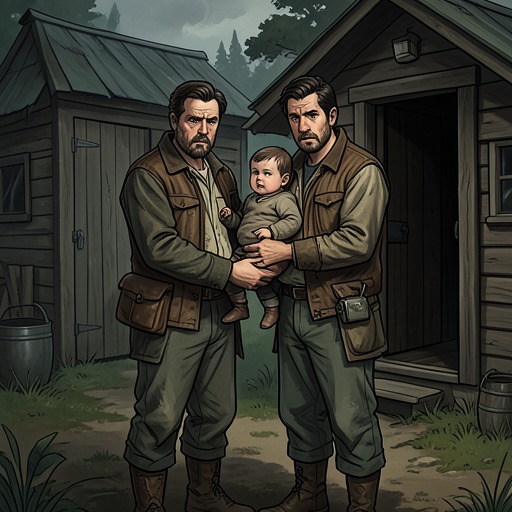
Eric and Andrew’s Partnership and Co-Parenting
The Cabin at the End of the WorldEric and Andrew’s Partnership and Co-Parenting is defined by a balance of playful intimacy, shared parental responsibility, and loyalty tested under threat. The two men bring different temperaments to raising Wen, but treat those differences as complementary roles rather than a source of division. When danger closes in around their family at the cabin, their partnership becomes practical as well as affectionate: Andrew imagines a dangerous escape plan, and Eric insists that they leave together.
Shared Parenting and Imperfection
Andrew’s advice to Eric about parenting draws on a history the two have built together. Before adopting Wen, they spent weeks discussing how to raise a child, including the danger of yielding to what Andrew calls “lizard-brained fear.” He has often followed that principle with academic arguments about the value of unsupervised play for children’s intellectual and emotional development. The conversations make their parenting a considered undertaking, not simply a set of instincts; they have tried to anticipate their fears and decide how those fears should shape Wen’s freedom.
In the moment captured here, Andrew tells Eric that even the best fathers worry, nag, and make mistakes, and that Eric must allow himself—and Wen—to be imperfect. The advice is both reassurance and a reminder that parenting cannot be made risk-free by vigilance. Eric is not presented as careless: he is worried enough to say he will go outside to see how Wen is doing. Andrew’s response asks him to distinguish care from the impulse to supervise every uncertainty away.
Their household roles have settled into a pattern that both find reassuring. Eric is struck by the contrast between Andrew’s whimsical, carefree manner as a parent and his persnickety, precise academic persona. The narration describes the roles as ones they have embraced, while also recognizing the conflicting qualities of parenthood: it is wonderful and fulfilling, but also frightening, alienating, and all-consuming. Their partnership does not erase those tensions; it gives them a shared language and routine through which to live with them.
Affection, Play, and Complementary Roles
The marriage is also rendered through easy physical play. Andrew swats at Eric with his book, Eric dodges and then pulls the book from the air, and Andrew drags him onto a picnic bench as they wrestle over it. Their joking argument about being hit with “magical realists” turns into light jabs and a warm kiss. The scene makes affection visible in ordinary gestures: teasing, mock combat, and a kiss are part of the same exchange. Neither man has to remain in a fixed role as the responsible one or the one being cared for.
That flexibility echoes their division of parental labor. Andrew is the parent who offers Eric a reasoned permission to loosen his grip, while Eric’s concern for Wen remains present and active. The relationship is not depicted as a simple contrast between a relaxed father and an anxious one; Andrew’s advice acknowledges that worry is part of even good parenting, and Eric accepts the reassurance without giving up his care for their daughter.
Partnership Under Threat
When Leonard and the others refuse to leave, Eric initially speaks with measured restraint. He tells them they have been heard, rejects their request, and asks them to go. The narration registers a fissure beneath his calm, and Wen is described as falling into hopeless darkness at the change in his voice. Andrew responds by rushing across the room, placing himself in front of Eric, and demanding that the visitors leave. His protective movement is immediate, but Eric then curls an arm around his husband’s chest and pulls him back. Andrew does not resist. The brief reversal matters: one shields the other, then steadies him, without turning their different reactions into a contest.
Their shared decisions become even clearer when Andrew quietly proposes an escape through the front door. He reaches for the keys and offers to go first, hold the visitors off, and let Eric and Wen reach the SUV; if he cannot catch up, he tells them to leave anyway and get help. The plan gives Eric and Wen a possible route to safety, but at the cost of Andrew separating himself from them. Eric refuses the terms, telling Andrew not to give him the keys and insisting that if they leave, all of them leave together. His answer rejects a version of protection that saves part of the family by abandoning another part.
Family as a Shared Commitment
Wen’s presence makes the stakes of their partnership concrete. She tugs on Eric’s arm and asks whether she can have something to hold just as purposeful footsteps sound on the back deck. Her request places the adults’ protective decisions beside a child’s immediate attempt to participate in what is happening. The scene does not resolve the danger in these moments; instead, it shows Eric and Andrew confronting it as co-parents, with Wen beside them and their choices bound together.
Across these scenes, their marriage is expressed less through declarations than through practiced coordination: Andrew’s counsel about giving Wen room to make mistakes, Eric’s attentiveness, their playful closeness, and their refusal to separate when escape becomes imaginable. The same partnership accommodates difference and establishes a limit. They may take turns calming, shielding, or challenging one another, but when the family faces a threat, neither treats the other as expendable.